Events
The Event Management module is able to process large amounts of unfiltered signals or events in order to facilitate the general management of multiple heterogeneous data sources.
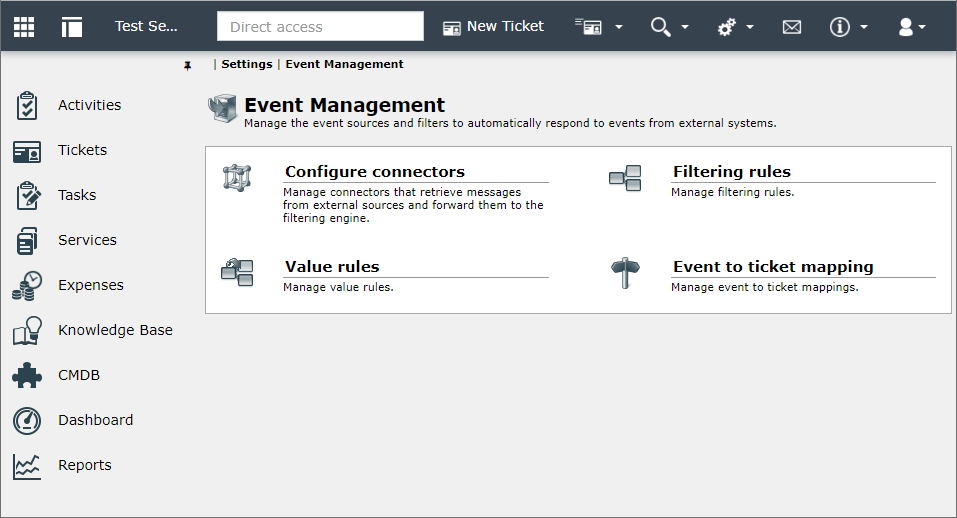
The primary benefit of this module - compared to other modules, like Mail2Ticket - is the option to filter incoming events on a lower level before they reach the workflow engine. Thus, the AEM can ensure complete and automatic filtering, processing, and collecting of signals, events, and tickets in your IT infrastructure. The AEM allows for converting filtered signals and events to tickets based on workflows as well as for processing signals and events on various protocols and data sources (e.g. SNMP, SQL, etc.). The simple handling of the AEM enables even employees without a technical background to monitor and configure the configuration on their own.
A typical example for the application of this module is the monitoring of system environments, like data centers, in which most of the events are indicators of normal operation. Other types of events that may indicate errors will result in the creation of a ticket.
Chapter 1 explains the configuration of the two different connectors used as interfaces to external data sources. Afterwards, Chapter 2 and 3 illustrate the use of filtering and value rules necessary for filtering incoming events. The event-to-ticket mappings are detailed in Chapter 4. These mappings are used for creating tickets based on events.
Chapters:


 Copyright (c) 2000-2026 Isonet AG